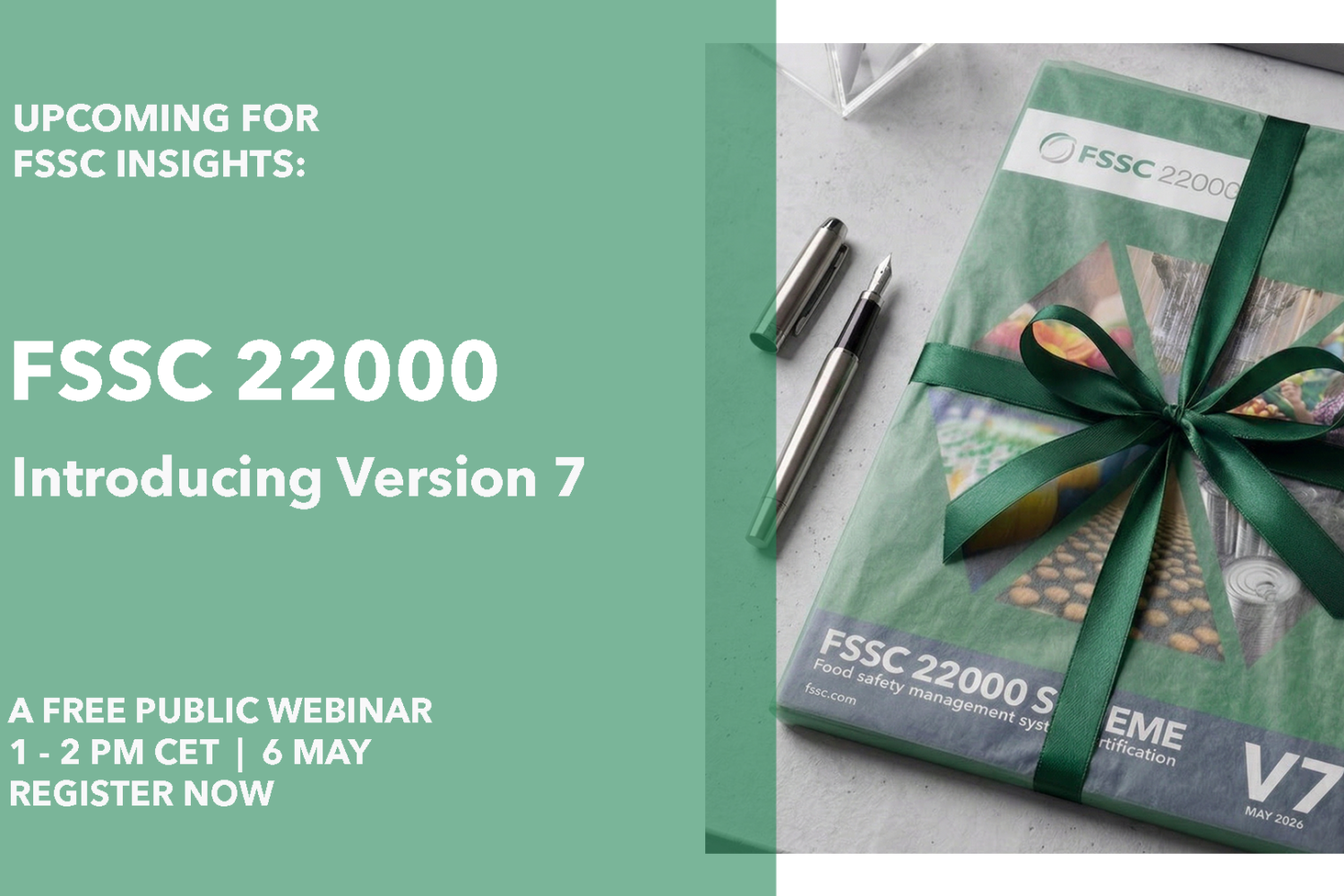
We are pleased to inform you that Version 7 (V7) of the FSSC 22000 Food Safety Management System Certification Scheme has been released.

V7 is based on the following normative documents:
- ISO 22000:2018 requirements for any organization in the food chain;
- Relevant Prerequisite Programs (PRPs) for the sector based on the ISO 22002-x series
- FSSC 22000 Additional Requirements (Scheme, Part 2) as determined by our stakeholders.
The Main Drivers for updating to V7 are:
- Incorporating the new ISO 22002-x series on Prerequisite Programs
- Aligning the Certification Scheme with the Global Food Safety Initiative (GFSI) benchmarking requirements 2024
- Strengthening the requirements to support organizations in their contributions to meeting the UN Sustainable Development Goals (SDGs)
- Providing a more defined structure for the division of food chain (sub)categories
- Editorial changes and amendments as part of continuous improvement
Overview of the changes
New ISO 22002-x series
Version 7 has shifted from the previous Prerequisite Programs (PRPs), namely the BSI PAS (Publicly Available Standard) and the ISO/TS 22002-x (Technical Specifications), to the new ISO 22002‑x:2025 series. This shift was brought about by ISO’s fundamental restructuring and modernization of the PRP requirements.
Published in July 2025, the new ISO series introduced a unified baseline PRP standard, ISO 22002‑100:2025, which consolidates common requirements across the food chain and reduces duplication, variability, and complexity that existed in the previous ISO/TS documents.
Part 100 is supported by sector-specific parts linked to the organization’s scope, e.g., ISO 22002-1, which focuses specifically on food manufacturing and must be applied in addition to Part 100. This harmonized structure provides clearer, more consistent requirements and supports a more globally applicable audit approach.
Strengthening requirements to support organizations in their contributions to meeting the SDGs
To further support Food Loss and Waste (FLW) reductions and sustainable food packaging, we have included some of the Save Food Packaging design principles in V7. Developed by the Australasian Institute of Packaging (AIP) and globalized by the World Packaging Organization (WPO), these design principles are applicable to all FSSC 22000 (Certified) Organizations involved in the design of packaging materials.
Auditor requirements
The requirements for auditor qualifications have been updated in line with the new GFSI Benchmarking Requirements and to harmonize competency criteria linked to a more structured division of food chain (sub)categories. This approach places further emphasis on competencies, including knowledge of products, processes, practices, laws, and regulations.
The use of AI
AI use in certification requires a governance framework that ensures an ethical, fair, and compliant application, including risk assessments, validation, monitoring, and clear roles. With proper training, transparency, and stakeholder communication, AI should support, not replace, human judgment.
Benefits of V7
- One common PRP standard, with additional sector-specific parts. This simplifies implementation for multisector organizations.
- Additional requirements on packaging design principles contribute to FLW reduction and thus further support the UN SDGs.
- Further details in the Scheme document for better understanding and application.
Timeline and Process
- The process is similar to the previous V6 upgrade of the FSSC 22000 Certification Scheme with a 12-month transition.
- Audits against V6 are permitted until 30 April 2027.
- Upgrade audits against V7 shall be conducted from 1 May 2027 until 30 April 2028.
Click here to view the V7 Scheme Documents