Insights Webinar FSSC 22000: Hygienic Transport of Food Through Effective Tank Cleaning
This event has passed.
This event has already been held. We're very thankful for the reception and participation of those who attended. If you could not join us on the day, we still have some information that might interest you. On this page, besides the main details of the event, you can also find recordings, documents, notes, and Q&As. Feel free to browse these documents, share them, save them, or download them for later. On the right side of the screen, you'll find all links and documents related to the event. Underneath the article, you can find any related Q&As.
This final FSSC Insights webinar of 2025 was held on 3 December at 1 PM CET and takes a closer look at how organizations can strengthen their hygiene practices through FSSC 22000 Additional Requirement 2.5.10 on transport tank cleaning.
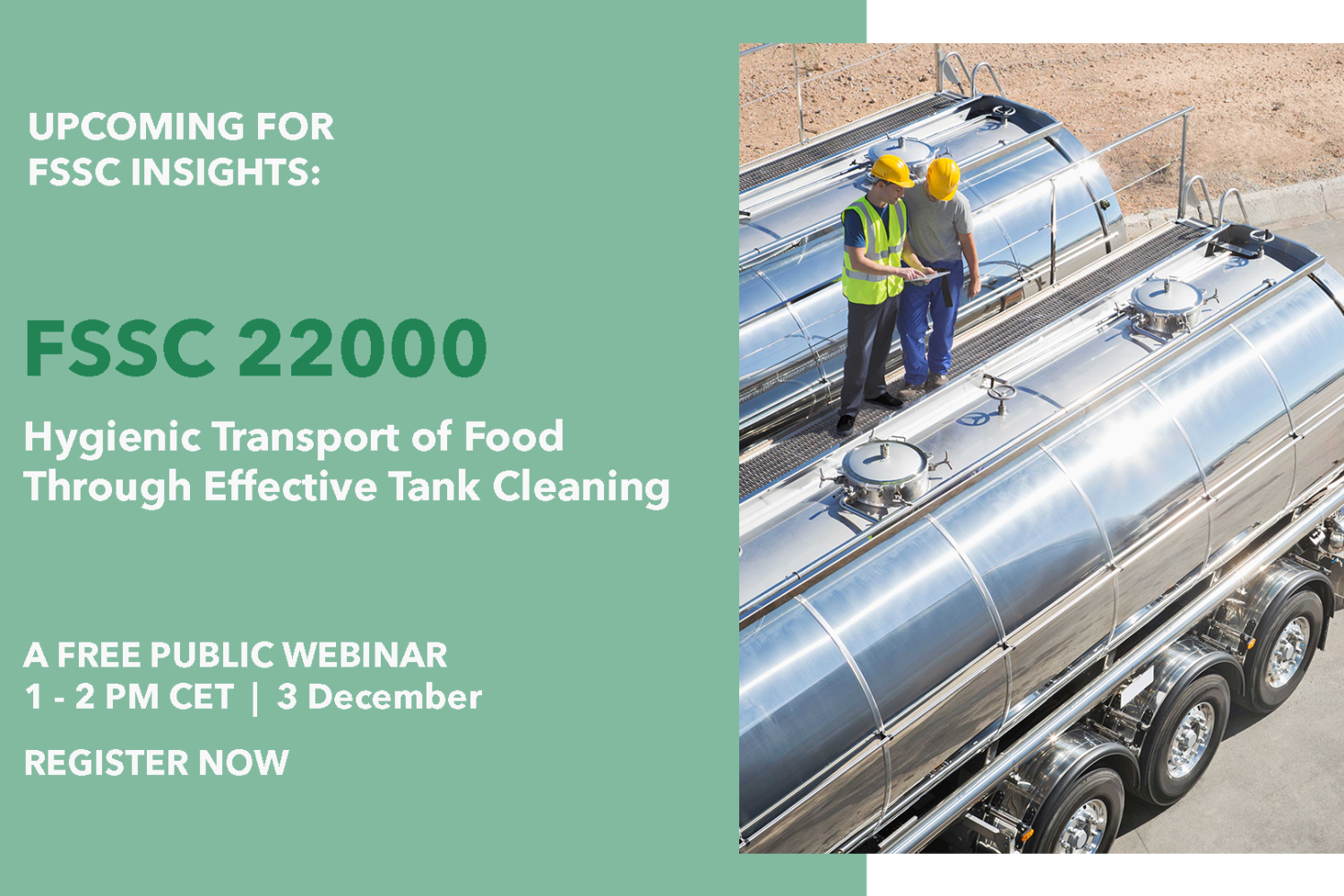
FSSC 22000: Hygienic Transport of Food Through Effective Tank Cleaning
On December 3, 2025, Foundation FSSC hosted a webinar focused on food safety transport requirements and transport tank cleaning requirements under the FSSC 22000 Certification Scheme. Kelly Mulholland (Technical Manager Safety and Quality at FSSC) explained Scheme requirements, while findings from industry analysis were presented by Vladimir Surčinski (Vice President and CEO of ENFIT, the organization for European & international standards for food, feed, and chemical safety in the supply chain).
This webinar builds on FSSC’s broader commitment to food safety and sustainability. For more insights, explore our article on Reducing Food Loss and Waste with Food Safety Management Systems.
FSSC 22000 Requirements: Clause 2.5.10D
In the webinar, Kelly Mulholland outlined FSSC 22000 clause 2.5.10D requirements, which are critical for meeting food safety transport requirements. She explained that organizations transporting finished products in tankers must implement a documented, risk-based plan. This should address potential sources of cross-contamination, define control measures, validate cleaning procedures, and ensure tanker cleanliness before loading.
For companies receiving raw materials in tankers, Mulholland emphasized the importance of supplier agreements. They should include cleaning validation, prior load restrictions, and appropriate control measures for maintaining food safety standards.
The session highlighted FSSC’s free guidance document, which provides detailed information on different transport tank types. Kelly emphasized the importance of comprehensive risk assessments that encompass physical, chemical, microbiological, and allergenic hazards.
Cleaning protocols must be validated, and verification methods should be based on risk assessment outcomes to comply with food safety transport requirements.
ENFIT Industry Findings on Transport Hygiene Risks
Critical Problems Identified
During the webinar, Vladimir Surčinski shared ENFIT’s Transport Hygiene Risk analysis of over 60 companies. He revealed an average industry score of Level 2, which is far below the 75% target. Borescope footage demonstrated that visual inspections and swab tests often miss contamination such as rust, residues, and mold in pipelines and air pipes.
Additional issues included compressed air contamination during unloading, inconsistent cleaning standards across Europe’s 650 stations, poor documentation of cleaning methods, and security gaps in seal integrity.
Cases were also reported where GMP Plus-labeled units transported both animal feed and food-grade products without proper controls in place.
ENFIT’s Proposed Solutions
To address these risks, ENFIT introduced standardized cleaning programs tailored to previous loads, a validation framework including worst-case scenario testing, and digital cleaning certificates with full traceability. Surčinski also highlighted the HQF-Certification for cleaning stations, aligning them with FSSC standards to ensure accountability and improve food safety in transport operations.
Target Audience
This webinar is designed for food safety professionals, quality managers, logistics coordinators, and anyone involved in transport and supply chain operations within the food industry.
Event rundown
Explore our insights
-
Insights Webinar FSSC 22000: Hygienic Transport of Food Through Effective Tank Cleaning
Past event
|
3 December, 2025
-
Webinar: Action Plan Towards COP30 - Sustainable Food Systems
Past event
|
6 November, 2025
-
Insights Webinar FSSC 24000: Make with Care, Certify for Trust
Past event
|
22 October, 2025