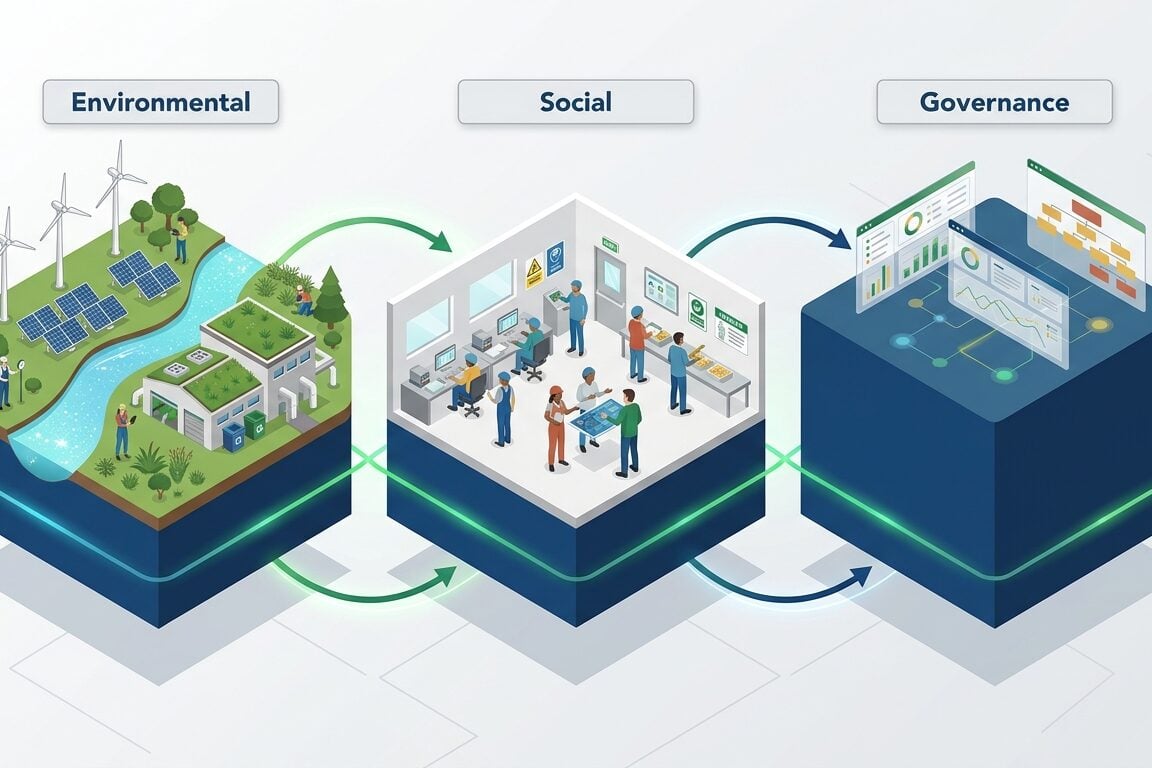
Discover the VSME standard, a simplified ESG reporting framework designed for SMEs.
The VSME is a new European standard developed specifically for SMEs. It was developed by EFRAG to simplify and standardize ESG reporting. The framework is tailored for SMEs to help them respond more easily to sustainability data requests from banks, investors, and larger companies in their value chains.
The standard enables structured and comparable disclosures while remaining resource efficient. It is specifically designed for companies without dedicated sustainability teams, taking into account their limited time, data availability, and internal capacity.
What are the Benefits of VSME?
VSME offers a streamlined and easy-to-use sustainability reporting framework designed specifically for non-listed SMEs. Its key benefits are
- Reduced reporting burden– The standard reduces administrative burden for SMEs by simplifying how they respond to sustainability information requests from large companies and financial institutions subject to the Corporate Sustainability Reporting Directive (CSRD) and the CSDDD (Corporate Sustainability Due Diligence Directive).
- Better Supplier Readiness – Prepares for information requests from large companies covered by the CSRD.
- Improved access to finance– Banks and investors are increasingly asking for ESG (Environmental, Social, Governance) information. The VSME allows you to provide this information in a standardized way.
- Stronger Competitiveness – Transparency in the sustainability strategy strengthens the trust of customers, partners, and employees and ensures a strong market position.
- Earlier Risk Detection – Sustainability reporting helps gain early insight into ESG risks, especially in the supply chain, and targeted management of improvement measures.
What is the Scope of VSME?
- The VSME is voluntary
- Intended mainly non-listed SMEs and micro-undertakings outside CSRD
- Aligned with the European Sustainability Reporting Standards (ESRS) which large companies must use for their reporting under the CSRD on topics such as climate, environment, and human rights.
- Covers the same Environmental, Social & Governance (ESG) topics
- Tailored to the size, capacity, and needs of SMEs
Why does VSME matter?
Although the VSME is currently voluntary, early adoption clearly offers a competitive advantage. Companies that strategically integrate ESG criteria can build greater market trust while also driving internal efficiencies and innovation potential. In addition, they are often preferred in public tenders.
In times of economic uncertainty, focusing on innovative, resilient, and future-proof business models becomes increasingly important. The VSME Standard supports this transition by providing a structured yet pragmatic approach to sustainability, helping companies move forward while keeping administrative demands manageable.
How does the VSME work?
The VSME consists of two modules: Basic (B) and Comprehensive (C), each serving a distinct purpose.
The Basic Module includes eleven reporting requirements, covering general sustainability policies and initiatives, along with metrics across Environmental, Social, and Governance topics. This makes the B module especially suitable for companies seeking to enhance transparency without the complexity and resource demands of full ESG reporting.
The Comprehensive (C) module builds on the foundation of the B module, enabling SMEs to present a more complete picture of their ESG performance. It introduces a stronger focus on policies and strategic direction, delves deeper into the topics covered in the Basic module, and expands the scope to include additional ESG areas. As a result, companies can better meet stakeholder expectations while still maintaining a level of effort significantly lower than that required by CSRD standards.
What do Companies need to consider?
- Understand the VSME standard and decide whether to adopt it for their company.
- Assess whether to report in accordance with the basic or the comprehensive module.
- Prepare a gap assessment to assess what information needs collecting and whether systems, processes and controls need to change.
- Monitor development of the future voluntary sustainability reporting standard closely, as it could differ from the VSME standard.
Conclusion
In conclusion, VSME is valuable in that it reduces reporting burden, enhances consistency in ESG disclosures, and strengthens preparedness for supply chain and finance-related requirements. For SMEs, it should be viewed not merely as a voluntary reporting tool but as a strategic business asset that reinforces credibility, strengthens resilience, and enables long-term preparedness.